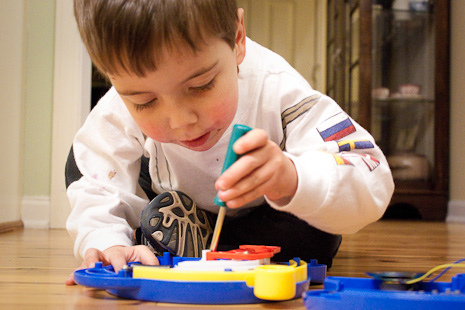
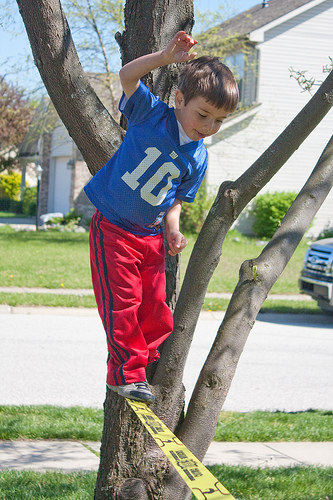
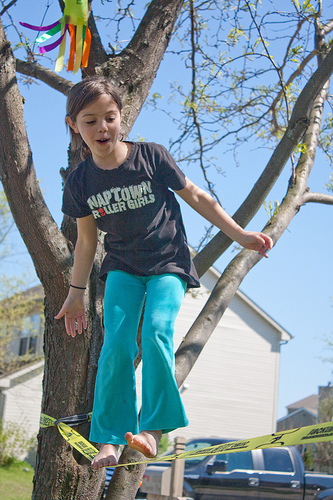
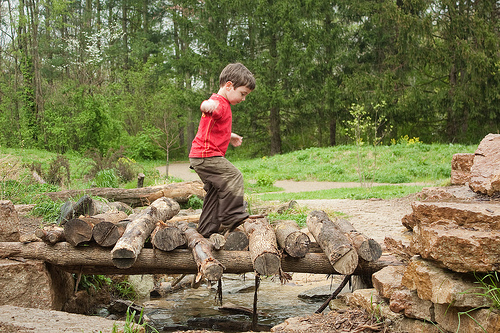
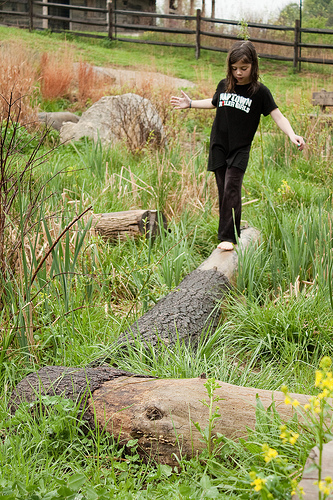
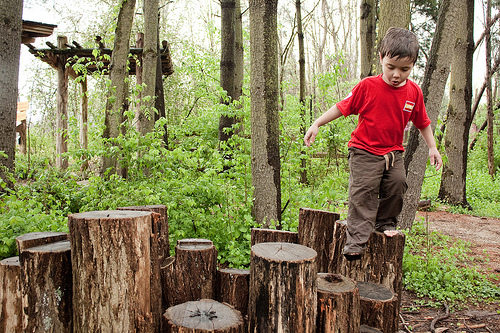
Left to their own devices, kids come up with amazing ways to keep themselves entertained.
This is the second part in a series of discussions regarding The Idle Parent Manifesto, which can be found in Tom Hodgkinson’s book The Idle Parent: Why Laid-Back Parents Raise Happier and Healthier Kids . Need to get caught up? You can do so here.
We pledge to leave our children alone.
Before we delve into this part of the manifesto, let me define what I think the author is saying here. I believe he means we leave children to their own devices as much as possible when we are together, as opposed to leaving the children alone in the home while we are out.
It sounds easy enough, doesn’t it? Isn’t that what we crave as parents of young children, to just be left alone for a small part of our day? To have a portion of the day when we’re not being chatted at, tugged upon, cried for? And yet, if you really think about your day, there are many missed opportunities for us to leave the children alone.
I’m as guilty as anybody, especially with my oldest. She has always been an independent spirit. Even at an early age, she would get immersed in some kind of play, giving me long stretches of time to do my own thing. Instead of relishing these moments, I felt pulled to interact, to interject myself into her private world.
“What are you playing? Oh? I love the way you set those blocks up. Very nice. Would you like me to get down some of those other blocks? No? How about those little animals? Are you getting hungry?”
Inevitably, this interruption served only to disrupt her play and remind her that I was there at her beck and call. Why not just leave her alone?
It can be unsettling to feel unneeded. As a stay-at-home mom, I often feel guilty if a stretch of time has gone by where I haven’t tended to some need. I imagine a parent who works outside the home might feel a similar kind of guilt if they’ve been gone for a stretch only to find that once home, their children are off in their own world. As parents, we haven’t been made to feel that these moments are victories. Instead, we see them as one more missed opportunity, one more chance to be doing something.
Even more frustrating is offering help or paying attention only to get rejected or taken advantage of. The author says,
“What better way to state one’s own desire for independence than to reject what’s offered? Think how we hover about them and encourage the development of likes and dislikes when they are little, and the disastrous results: “Some water? No, not water? Some juice perhaps? Apple? No? Orange, then. In the blue cup? The red cup, then. Please don’t throw it it on the floor. Henry, if you do that again, you’ll be out. Did you hear what I said?”
Again, guilty as charged. How many moments during the day do we do just this - take situations where children are perfectly capable of managing themselves and instead micro-manage them? And then we wonder how they became such demanding little creatures. We’ve hammered it into their little brains that they are not capable, or that life couldn’t possibly be so simple.
My youngest is not the independent soul that his sister is. Or was he? He is both the youngest and my last, and I’ve noticed my tendency to hover and baby him. And while it was cute to be followed around by a toddler, having a near-kindergartner who can’t tie his shoes or entertain himself isn’t nearly as charming. On the days when we’re home together, he needs me constantly. Sometimes he panics when he realizes he’s been left alone downstairs. I feel as if no matter how much I engage him, when it’s time for me to get something done he can’t come up with his own entertainment.
The author suggests you try an experiment: say yes more often and see if they bug you less. His reasoning is that if kids know they can have your undivided attention for any reason, no matter how small, they stop asking. Here’s the kicker, though: let them come to you - do not interfere, but when they do come, be there for them.
I’m ready to try it, especially with three months of summer vacation ahead of us. I wonder how much of Eli’s need for me to pay attention to him stems from too many interactions where I haven’t given him my full attention. Playing LEGOS while checking Facebook, listening but not really listening. Or is it a combination of that and hovering? When someone is always there, ready to offer the next entertainment or toy like a cruise ship director, how can children learn what boredom feels like? More importantly, how can they learn to creatively battle boredom with their own ideas?
The author believes that passive parenting is responsible parenting. What do you think? Does being a passive parent and leaving children to figure things out on their own build character? Or do you believe it’s just another excuse for parents to do their own thing?









Recent Comments